Why are we training? What are we actually trying to accomplish?
Are we trying to become better at performing exercises? Preserve a tradition? Become increasingly faithful to a teacher's methodology? Or acquire genuine physical capabilities we couldn't previously reproduce?
The primary goal is to develop measurable, reproducible skills that remain effective under resistance and changing conditions. Establish three foundations:
Goals: What capabilities are we trying to acquire?
Blockers: What prevents us from acquiring them?
Measurement: How do we determine whether training works?
The goal is not for students to leave impressed by the instructor. It is for them to leave more capable than when they arrived.
Don't measure how much you've practiced. Measure what your practice has made you capable of doing.
02 / 13
The Two Fundamental Obstacles
People are often limited by the very things they believe are making them successful.
Physically, we hold on to unnecessary tension. Mentally, we hold on to unnecessary certainty.
Muscular habits may initially make us stronger but later limit adaptation. Explanations may initially help us understand but later prevent us from learning something new.
Your body is holding on to tension it doesn't need. Your mind is holding on to explanations that no longer serve you. Both are preventing you from discovering what you're actually capable of.
In the bodyUnnecessary tension.
Bracing that once helped can begin to limit adaptation.
In the mindUnnecessary certainty.
An explanation that once helped can begin to prevent learning.
03 / 13
The Reference-Group Effect: The Illusion of Mastery
Practitioners evaluate their capabilities relative to the people they train with. Consistently training with less-skilled partners can create a distorted sense of one's limits. Improvement may be genuine, and a practitioner may be much better than average, but a narrow reference group may conceal how much remains possible.
A practitioner can spend decades feeling successful without encountering sufficiently challenging partners to expose their limitations.
Being better than everyone around you doesn't mean you're approaching the limits of what's possible.
Seek meaningful challenges, capable partners, and independently measurable results.
04 / 13
Premature Equivalence: The Language of Not Learning
Listen for phrases such as:
"Oh, that's just like..."
"That's basically..."
"We already do that."
"My teacher teaches that."
"That's the same thing as..."
These are warning signs of premature equivalence. They do not automatically prove resistance to learning. A student may sincerely believe the experience is familiar because it looks or feels like something they already know. Yet a similar appearance or sensation can be produced by very different underlying mechanisms. Recognizing the feeling does not establish that the mechanism is the same.
In this seminar, investigate whether a familiar-looking result is being produced through a different organization: greater whole-body unification and integration, with less unnecessary tension. Those differences can create opportunities for growth beyond what your current way of producing the result allows. The question is not only "Have I felt this before?" but "What is producing it, what is different, and what further refinement does that difference make possible?"
The aim is to develop the ability to refine beyond your current limits. A successful result is a starting point for further investigation: you can keep discovering unnecessary tension to release and ways to become more unified and integrated. Refinement has no fixed endpoint.
Confirmation bias: Favoring evidence that supports existing beliefs.
Motivated reasoning: Interpreting evidence to protect a preferred conclusion.
Identity-protective cognition: Defending beliefs because they have become part of one's identity.
Cognitive dissonance: Discomfort when evidence contradicts established beliefs, sometimes leading to rationalization.
Assimilation versus accommodation: Fitting new experiences into existing models versus revising those models to explain genuinely new information.
Recognizing similarities can be useful, but similarity does not establish equivalence.
The moment you decide you've already understood something, you may have eliminated your opportunity to learn it.
Replace "That's just like something I already know" with: "What's different about this that my existing understanding cannot explain?"
A reference for investigation
Use these concepts to examine your own learning, without diagnosing other people.
Reference-group effect+
We judge our capabilities relative to the people around us. A narrow training group can hide limitations. Seek capable partners and independent tests.
Illusion of mastery+
Success in familiar conditions can feel like reaching the limits of a skill. Change the partner or conditions and check what remains reproducible.
Premature equivalence+
Assuming that a familiar appearance or sensation means the underlying mechanism is the same. Similar results can arise through very different organization. Investigate what allows greater integration, less unnecessary tension, and continued refinement beyond your current limits.
Confirmation bias+
Favouring evidence that supports existing beliefs. Deliberately look for a result your current explanation cannot account for.
Motivated reasoning+
Interpreting evidence to protect a preferred conclusion. Decide what result would challenge that conclusion before testing.
Identity-protective cognition+
Defending beliefs because they have become part of your identity. Separate the value of your experience from the question of whether a method works.
Cognitive dissonance+
Discomfort when evidence contradicts established beliefs, sometimes leading to rationalisation. Notice the discomfort and keep investigating.
Assimilation / accommodation+
Assimilation fits new experience into an existing model. Accommodation revises the model to explain genuinely new information. Ask which the evidence requires.
Methodological attachment+
Protecting a training method because of the time, effort, relationships, or identity invested in it. Return to the capability you wanted to acquire.
Illusion of learning+
Feeling productive, understanding an explanation, or improving with coaching can be mistaken for lasting learning. Test independent reproduction and later retention.
05 / 13
Identity, Lineage, and Methodological Attachment
Practitioners invest years or decades in teachers, organizations, and systems. Their investment includes time, money, relationships, effort, and identity. Questioning a methodology can begin to feel like questioning themselves.
Success confirms the method. Failure is explained as needing more practice. The methodology itself is rarely tested. At its extreme, this can create a cult-like training culture where loyalty becomes more important than measurable results.
The purpose of training isn't to become increasingly faithful to a methodology. It's to become increasingly capable.
The objective is not to replace one unquestioned authority with another; it is to replace unquestioned loyalty with independent investigation.
06 / 13
What Does It Really Mean to Empty Your Cup?
Emptying your cup does not mean throwing away knowledge, evidence, or experience. It means releasing attachment to being right.
The instructor spent fourteen years training intensively with a former teacher, including extensive direct hands-on practice. That training produced substantial improvements. Eventually, however, the instructor encountered limitations, particularly persistent unnecessary muscular tension, that he could not reliably resolve through the methodology he had learned.
He began investigating independently, experimenting, troubleshooting, and measuring results, and developed approaches that renewed his progress. This is the instructor's firsthand experience, not proof that all practitioners of another system experience identical limitations.
Changing a methodology does not require denying the value of previous experience. It requires recognizing when results suggest a different approach works better.
Emptying your cup doesn't mean throwing away your knowledge. It means releasing your attachment to being right.
Ask: "What evidence would convince you that your current understanding is incomplete or incorrect?"
This question applies to the instructor's own methodology, too. If something demonstrably better appears, investigate it.
07 / 13
The Physical Equivalent: Unnecessary Tension
People often carry unnecessary muscular tension. When meeting resistance, they instinctively brace, tighten, and compensate. Some training methods improve body organization substantially while leaving unnecessary tension intact. Because those patterns initially produced success, practitioners may protect them.
Under pressure they tighten further, or switch among disconnected movement strategies instead of adapting continuously.
The seminar's methodology emphasizes recognizing and releasing unnecessary tension while retaining the muscular activity needed for posture, movement, and force transmission.
The goal is not zero tension. The goal is nearly zero unnecessary tension.
The mental and physical obstacles share a theme: holding on to something familiar when the situation requires adaptation.
08 / 13
Three Levels of Training: Effects, Mechanisms, and Integration
These levels are the instructor's conceptual framework, not a universally established ranking of martial arts.
Level One: Reproducing Effects. In some conventional Aikido training, students reproduce the visible movements produced when a highly organized body meets a less organized one, without necessarily developing the underlying organization.
Reproducing the appearance of a capability is not the same as acquiring the capability.
Level Two: Developing Internal Mechanisms. Internal training can produce substantially better body organization, but practitioners may still retain tension, compensation, and disconnected movement strategies. A plateau may result.
Level Three: Continuous Integration and Adaptation. Develop the capacity to notice and release unnecessary tension, maintain coherent organization, and adapt continuously under changing resistance rather than consciously cycling through separate mechanisms.
The key question is: Does the methodology produce the capabilities it claims to develop?
09 / 13
Troubleshooting: The Foundation of Effective Learning
Repetition is valuable, but repetition alone cannot show whether the intended capability is developing.
Repetition makes a pattern more automatic. It doesn't necessarily make it more correct.
Attempt: Try to produce a specific physical result.
Measure: Determine whether the result occurred.
Diagnose: Identify what prevented success.
Correct: Change a specific tension, compensation, or organizational problem.
Retest: Repeat the task and observe the difference.
Reinforce: Repeat the successful organization until it becomes reliable.
Verify: Test independent retention and transfer across partners and conditions.
Immediate coached improvement is not necessarily durable learning. The student must eventually reproduce the result without the teacher.
Troubleshooting discovers what works. Repetition stabilizes it. Independent testing verifies that learning occurred.
Discover through feedback. Stabilize through repetition. Verify through testing. Refine through troubleshooting.
Feeling productive is different from producing measurable improvement.
Explore each step. Then put it to the test.
Try to produce a specific physical result. What exactly are you trying to do?
Determine whether the result occurred. What can you reproduce right now?
Identify what prevented success. Where did you brace, compensate, or lose organisation?
Change a specific tension, compensation, or organisational problem. Change one thing so you can investigate its effect.
Repeat the task and observe the difference. Use comparable resistance and compare with your baseline.
Repeat the successful organisation until it becomes reliable. Stabilise the result, rather than repeating an unsuccessful pattern.
Test independent retention and transfer across partners and conditions. Can you reproduce it later, without the teacher?
Attempt
Try to produce a specific physical result.
What exactly are you trying to do?
10 / 13
Three Physical Challenges
The goal is not simply to demonstrate what the instructor can do. It is to help students acquire capabilities they couldn't previously reproduce.
Begin with an observable limitation. Change something specific. Find out whether the result lasts.
Challenge 1 · Illustrative, not a technique prescription
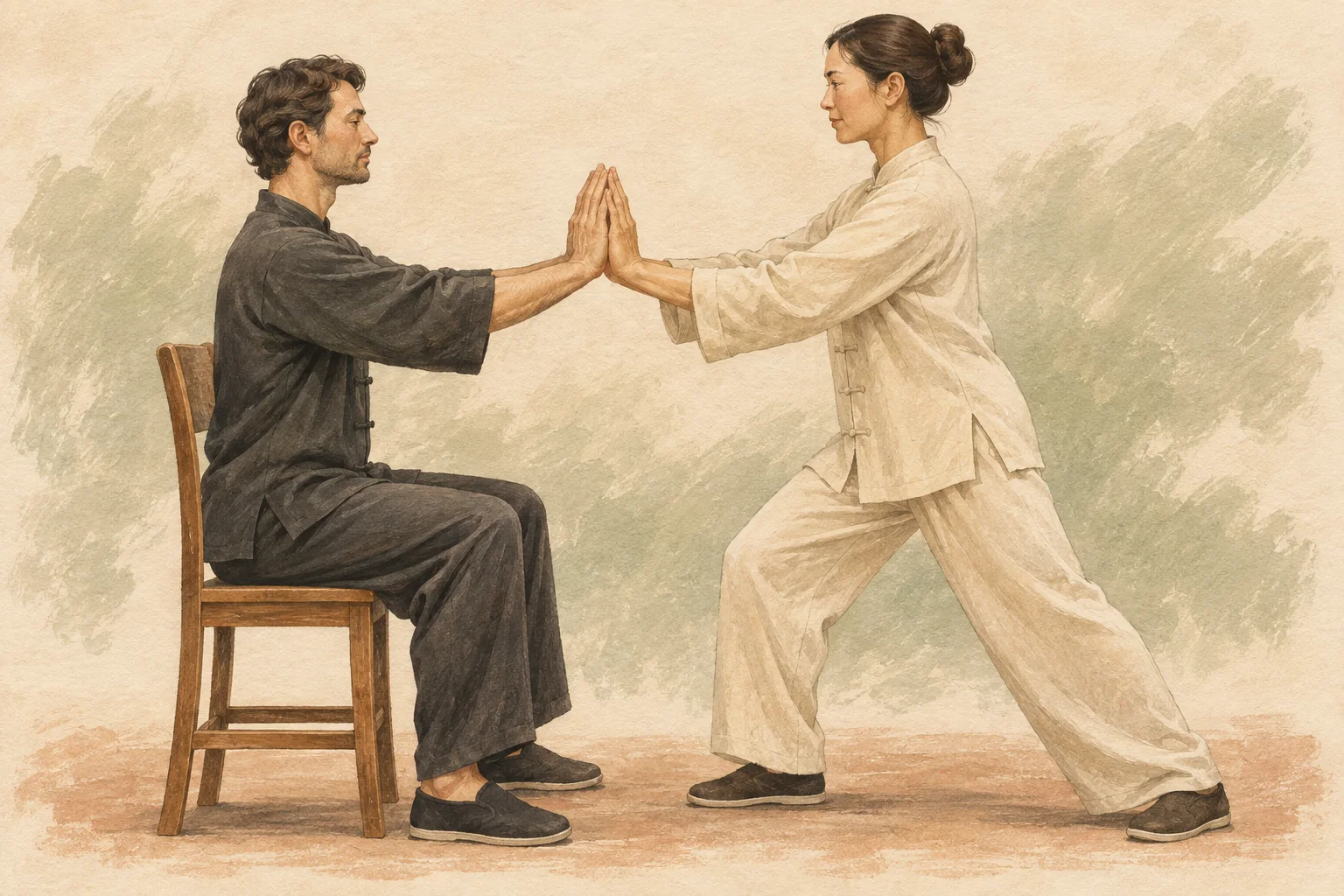
Rising from a chair
Stand against controlled resistance without unnecessary bracing.
Baseline test
Sit on a sturdy chair, hands extended to a standing partner. With supervision, agree on gentle resistance through the hands. Attempt to stand and note what happens without increasing force.
Common obstacles
Tightening the shoulders, gripping, or compensating with disconnected effort.
Troubleshoot & retest
Identify one area of unnecessary tension. Release what is not needed while maintaining posture and support. Repeat with comparable resistance.
Verify the learning
Reproduce the change without prompting, then check again later and with a different partner.
Challenge 3 · Illustrative, not a technique prescription
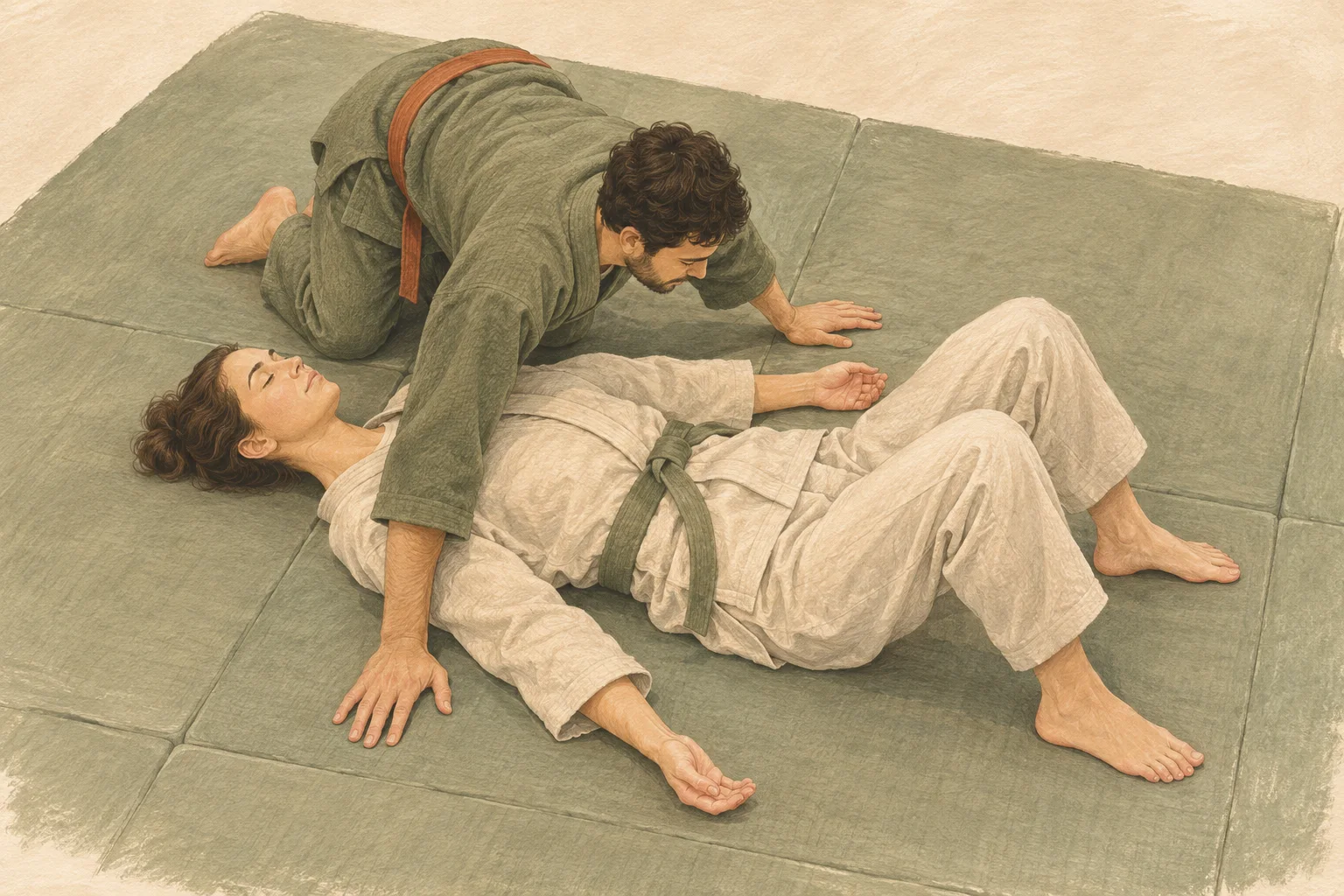
Rising from the floor
Investigate movement under carefully controlled upper-torso pressure.
Baseline test
Only with qualified hands-on supervision: one practitioner lies on padded mats while a partner applies carefully controlled pressure across the upper torso in a T-shaped arrangement. Agree on a comfortable, very light test, with the head and neck free.
Common obstacles
Relying solely on brute force, breath-holding, or tightening against pressure.
Troubleshoot & retest
The partner supports their own weight and releases immediately on request. Investigate a small change in organisation; reduce pressure whenever needed.
Verify the learning
Check independent movement at a safe, agreed level. Never increase weight to prove a result. Stop for pain, discomfort or breathing difficulty.
RED FLAG: "Watch how amazing I am." Students spend days watching impressive demonstrations, leave impressed with the teacher, but cannot show meaningful improvement themselves. They confuse witnessing skill with acquiring it.
GREEN FLAG: "Look how much more capable you are." Students begin with measurable limitations, receive specific instruction, demonstrate improvement, and later reproduce it independently.
A demonstration establishes what a teacher can do. Teaching establishes what a student can learn.
Don't judge a seminar by how impressive the teacher was. Judge it by what students can still do independently afterward.
“Watch how amazing I am.”
Leave impressed by the teacher, without independently measurable improvement.
Red flag · Demonstration without transfer
“Look how much more capable you are.”
Begin with a limitation, improve through specific instruction, then reproduce the result independently.
Green flag · Learning that lasts
12 / 13
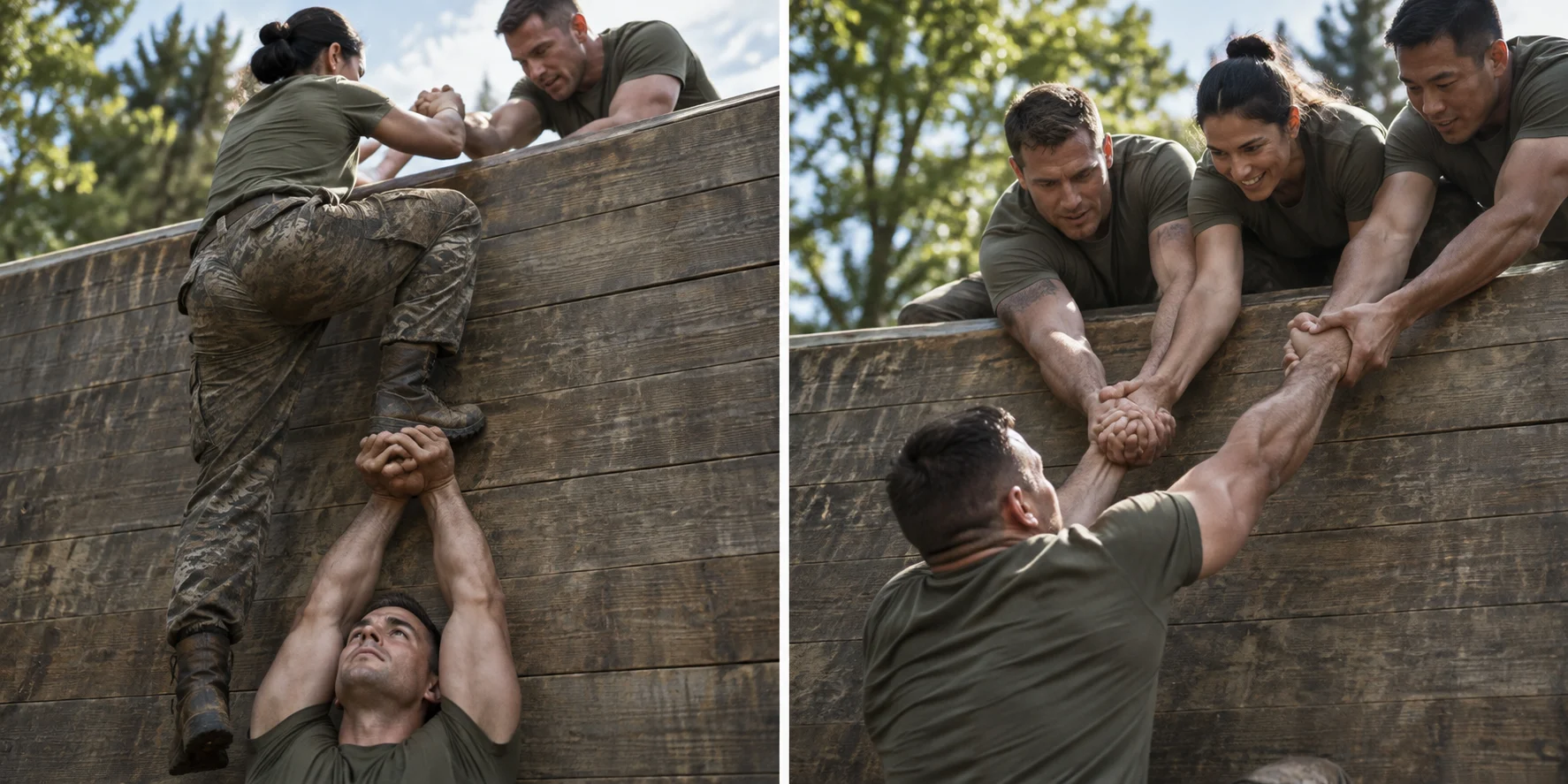
Over the Wall, Together
The goal of training is not to create permanent followers of a teacher. It is to create capable, independent practitioners who can eventually become peers, challenge one another, and help one another grow.
This is not a one-time graduation from student to equal. It is a repeating cycle over a lifetime: at different times, each person has something the others need, and each person can help someone else over the next wall.
The best teacher doesn't create a pedestal. The best teacher creates peers.
Help someone over the wall.Make a capability accessible that they could not yet reach alone.
The help comes back.Capable peers reach back and help their former teacher advance, too.
First I help you reach a place you couldn’t reach alone. Then you reach back for me. Over a lifetime of training, we take turns.
Illustrative obstacle-course metaphor, not documentary seminar photography or climbing instruction.
My methodology is designed around that outcome. Instead of asking students to preserve my exercises, terminology, or authority, I teach them to test results, diagnose limitations, remove unnecessary tension, and develop the ability to improve independently. When students can troubleshoot themselves and each other, learning no longer depends on one extraordinary individual. A student should eventually be able to challenge the teacher, reveal something the teacher has missed, and help the teacher improve in return.
From a teacher pedestal to a learning community
A teacher pedestal places one person's skill or authority permanently beyond the students. A teacher-centered system can make the founder's skill the permanent ceiling: students spend their careers trying to reproduce what the teacher can do, without acquiring the tools to test, extend, or surpass it.
If no one can reproduce or advance the founder's abilities, practical skill risks weakening as it passes from generation to generation. This is skill attenuation: demonstrations, vocabulary, and rituals may survive while the underlying capability becomes less reliable or is lost.
This is a risk and a critique of certain teaching structures, not a claim that every traditional lineage inevitably declines. A lineage can remain vital if it transmits skills reliably and encourages independent testing, innovation, and students who surpass their teachers.
A tradition survives by transmitting capability, not merely preserving the appearance of capability.
The alternative is a self-correcting community of peers. No one's authority places their ideas beyond testing. Surpassing the teacher is not a betrayal; it is evidence that teaching has succeeded. The teacher, in turn, remains a learner.
Distribute the capacity to learn
The seminar's troubleshooting cycle (Attempt → Measure → Diagnose → Correct → Retest → Reinforce → Verify) is not merely a way to improve an exercise. It is a way to distribute the capacity to learn.
Students learn to identify unnecessary tension and ineffective organization in themselves, recognize problems in training partners, communicate corrections that produce observable changes, and verify whether those improvements remain when the teacher is absent. Over time, this creates multiple sources of insight rather than one indispensable authority.
Independent reproducibility means being able to produce the result without the teacher's presence or prompting. The method must be judged by whether this actually happens:
Can students reproduce results independently?
Can they help each other improve?
Can they identify weaknesses in the instructor's explanations?
Can they produce new capabilities and teach them onward?
These are aspirations to test, not guaranteed outcomes. Measuring student improvement includes investigating whether the ability to learn is being passed onward.
A closing invitation
I don't want to spend my life standing on a pedestal while everyone else tries to imitate me. I want to teach you how to become capable enough to stand beside me. And someday I want you to discover something I haven't discovered, so you can help me improve, too.
Think about a team getting over a wall. One person interlaces his fingers and boosts the others up. But the job isn't finished when everyone else is on top and he's still standing below. They turn around, reach down, and pull him up with them.
That's what I want our training to become. Sometimes I'm the one helping you over the wall. Sometimes you're the one helping me. And over the course of our careers, we do that for one another again and again.
If a methodology requires the teacher to remain forever beyond the students, it risks dying with the teacher. If a methodology teaches people to investigate, correct, reproduce, and surpass what they were given, the skill can keep growing long after any one teacher is gone.
Don't build a pedestal. Build peers. Don't preserve dependence. Transmit the ability to learn.
The ultimate measure of a methodology is not how impressive its founder remains. It is whether the people who learn it become capable of standing beside, challenging, helping, and eventually surpassing one another, repeatedly, across generations.
13 / 13
Closing Message
I don't want you to leave here believing everything I say. I want you to leave better able to investigate your own training.
Question what you're doing. Measure whether it works. When you encounter something unfamiliar, don't explain it away with something you already know. When you meet physical resistance, investigate unnecessary tension. When you plateau, don't automatically prescribe another ten thousand repetitions. Identify what's blocking improvement.
Don't become so committed to defending a methodology that you lose sight of why you started training.
The purpose isn't to prove that what you already know is correct. The purpose is to become capable of things you cannot currently do.
Your practice. Your evidence.
A before-and-after worksheet for the things you can actually reproduce.
Notes stay in this tab unless you choose to save them on this device or download a copy. Nothing is submitted. Avoid personal or sensitive information on shared devices.
Six statements to return to.
1
Being better than everyone around you doesn’t mean you’re approaching the limits of what’s possible.
2
The moment you decide you’ve already understood something, you may have eliminated your opportunity to learn it.
3
Emptying your cup doesn’t mean throwing away your knowledge. It means releasing your attachment to being right.
4
Don’t measure how much you’ve practiced. Measure what your practice has made you capable of doing.
5
Don’t leave impressed with your teacher. Leave more capable than when you walked in.
6
The best teacher doesn’t create a pedestal. The best teacher creates peers.
Get out of your own way.
Your body is holding on to tension it doesn’t need.
Your mind is holding on to explanations that no longer serve you.
Both are preventing you from discovering what you’re actually capable of.
Release what isn’t serving you. Measure what works. And never stop learning.